AMABIT — An All-in-One Crypto Trading Platform
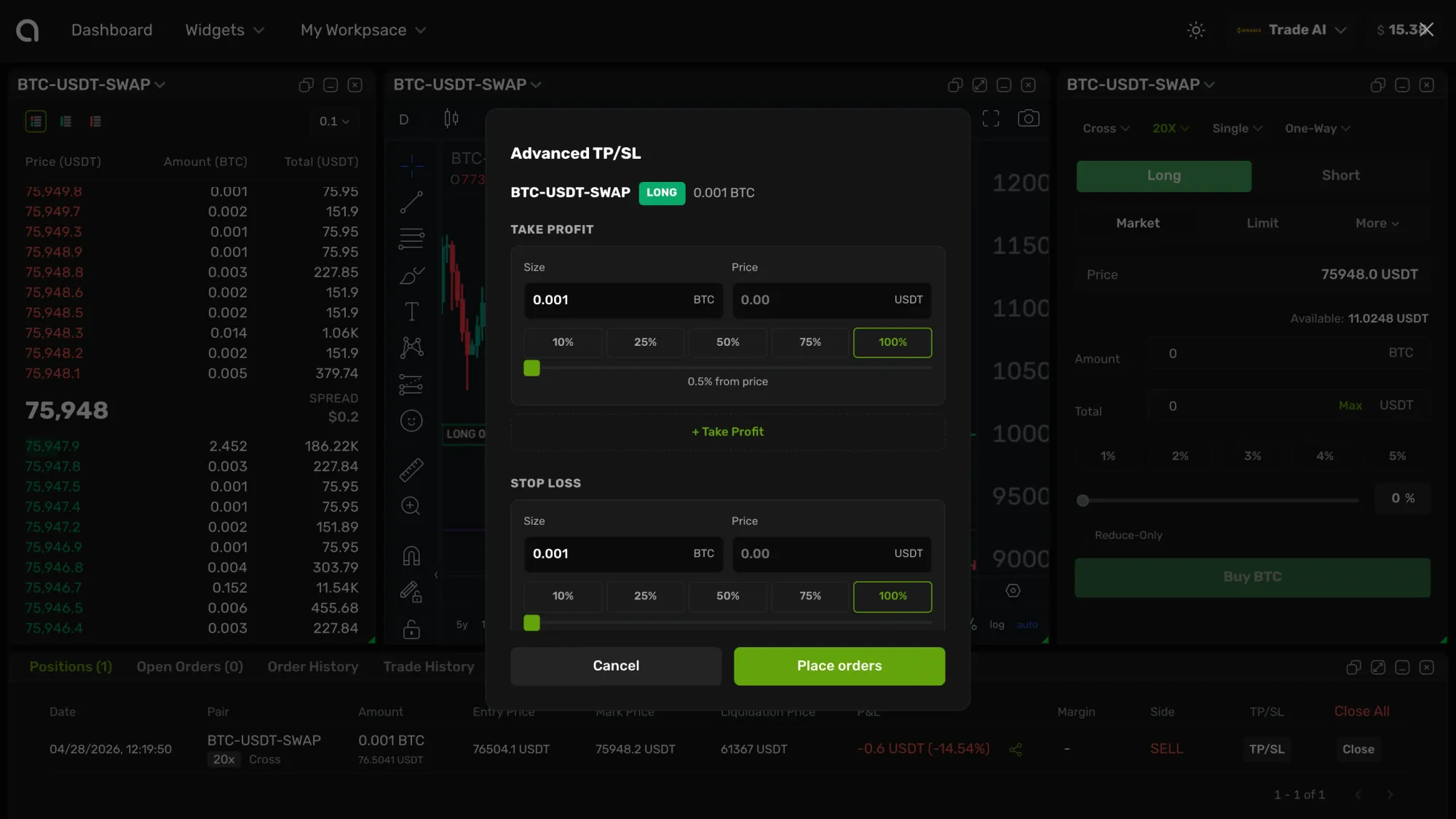
You open seven tabs to start your day.
Spot on Binance. Futures on a different page. A copy-trading site you joined months ago and don't quite trust. TradingView, paid monthly. A bot dashboard. A folder full of API keys.
You're not bad at trading. You're just doing seven jobs at once.
The price comes back a few seconds late. The fill drifts. You miss a setup because you were on the wrong tab. It adds up.
Why we built one platform instead of five
We were tired of being the glue between five vendors.
So we built AMABIT — one log-in, one KYC, one identity. Spot, futures, PAMM, TradingView automation, and trading bots. All on Binance liquidity, through our partnership with Binance.
You stop being the glue. The platform is.
The four problems AMABIT fixes
1. One log-in for spot, futures, PAMM, and bots
The benefit shows up every day, in small ways.
One log-in instead of five. One KYC instead of five. Charts and the trading terminal in the same window — no tab-flipping to read what you're about to trade.
Spot and futures still live in separate sub-accounts (that's how Binance is built underneath, so we keep it that way). You'll still move funds between them. What's gone is having five accounts on five sites with five passwords.
2. PAMM gives you the same fill as everyone else
On a copy-trading site, the leader places a trade and the system fires a copy for each follower. Each follower gets their own fill. Their own slippage. Sometimes a partial fill. Sometimes nothing.
The smaller your account, the more your fill drifts from the leader's.
PAMM is different. You and the Manager put money into one pool. The Manager places one order. It fills once. Your share moves with NAV — the same accounting managed funds use for theirs.
One trade, one price, your slice of it.
3. Your bot keeps running
Hooking TradingView into a broker usually breaks. Webhooks stop firing. The exchange changes its API. Your SDK falls behind the docs.
AMABIT's API is fully Binance-compatible. Any code that talks to Binance talks to AMABIT — unchanged.
TradingView gets two modes (Strategy and Signal), up to 5 take-profits, 5 stop-losses, trailing stop, hedge mode, and built-in dedup so duplicate signals don't double-fire.
4. You pay Binance fees, not platform fees
Most platforms take their own cut on top of the exchange. Wider spreads. Higher withdrawal fees. A subscription nudging you up the tier ladder.
We don't.
Zero platform fees. You pay standard Binance commissions and that's it. PAMM Members pay one extra thing — the Manager's Success Fee — and only when the Manager makes you money.
Four ways to use AMABIT
Self-directed trader
You already trade on Binance. The UI is starting to feel like work. AMABIT is the cleaner version.
Spot terminal with the full order set — market, limit, OCO, stop-limit, trailing stop, reduce-only.
Futures with cross or isolated margin up to 125x, plus multi-asset margin if you'd rather not park everything in USDT.
Sub-accounts to keep strategies apart. Charts in the same view as the order book.
PAMM Member
You want a strategy. You don't want to run it yourself. PAMM is your mode.
Open the marketplace. Read each Manager's public stats — AUM, drawdown, monthly P/L, win ratio. Check the vesting period and the fee terms.
Pick a Manager. Allocate. Your share moves with the pool.
The Manager only earns when they clear their last high-water mark. The incentive sits on your side of the table.
PAMM Manager
You've been trading well. You want to turn that into AUM.
A seven-step wizard sets up your account, deposit and vesting rules, fee model (Success Fee with HWM up to 50%, or a Management Fee up to 2% per month), affiliate tiers, which stats to show, and email + 2FA.
Members find you through the marketplace and through a shareable PAMM URL.
Billing. Distribution. Public stats. All built. One less thing for you to build yourself.
Bot or TradingView trader
Your strategy lives somewhere else. AMABIT is a drop-in.
Generate an API key. Lock it to your bot's IP. Point your existing code at it. Your python-binance script doesn't change. Your ccxt config doesn't change. Your Go bot doesn't care which credentials it's holding.
WebSocket streams behave like Binance — because they are Binance.
Driving from TradingView? AMABIT handles your TP/SL on the platform side, so your strategy doesn't have to.
Get started on amabit.io
Pick the path that brought you here:
- Self-directed trader — open a sub-account, fund it, trade spot or futures from the same terminal.
- PAMM Member — browse the Manager marketplace, read the stats, allocate.
- PAMM Manager — run the seven-step activation, set your fees, get a public PAMM page.
- Bot / TradingView trader — generate an API key after sign-up. Your existing code runs unchanged.
All four start the same way — with an account.